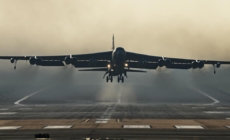
Investigators are trying to determine the cause of a B-52 bomber crash that killed eight Monday in California.
Here is what we know.
When and where did the crash occur?
The crash occurred during a “routine test mission” just after 11 a.m. at Edwards Air Force Base.
“Immediately after takeoff, it crashed and burst into flames,” Col. James Hayes told reporters at a news conference Monday afternoon.
A huge plume of smoke rose from the runway area.
A cause has not been determined and could take months to confirm.
The mission involved “supporting a local radar modernization program,” Hayes said.
Who was on board?
Eight people were aboard the B-52 and are presumed dead.
Their names have not been released.
Hayes told reporters that relatives of the victims were being notified.
“We lost eight great Americans. This crash is deemed to be unsurvivable,” Hayes told reporters, “and right now, our thoughts and prayers are with the families of those who lost their loved ones.”
Air Force Secretary Troy E. Meink added: “We are deeply saddened by the eight lives lost in [Monday’s] tragic crash at Edwards AFB. We mourn this loss and honor the service of our airmen, civilians and contractors who work every day to advance our mission. I send my sincerest condolences to their families and loved ones.”
An Air Force B-52 Stratofortress strategic bomber takes off from Fairford, England, on March 19.
(Leon Neal / Getty Images)
What do we know about the B-52?
The B-52 Stratofortress is described by the military as a “long-range, heavy bomber that can perform a variety of missions,” and is known as the “backbone of the manned strategic bomber force for the United States.”
There are typically at least five crew members on such a plane: an aircraft commander, pilot, radar navigator, navigator and electronic warfare officer, according to the Air Force.
The B-52 is legendary for its use and longevity. As Bloomberg reported in 2017: “In the world of heavy bombers, none has prevailed as long as the B-52 Stratofortress. The Cold Warrior joined the U.S. arsenal in 1954, eventually becoming part of a nuclear triad that, along with strategic missiles and submarines, was aimed at giving the Soviet Union pause. After the Berlin Wall fell, it slowly became an aerial jack-of-all-trades. With its long range, minimal operating cost and ability to handle a wider array of weapons than any other aircraft, it just didn’t make sense to get rid of it. Under the Air Force’s current bomber plans, the B-52 will fly until 2050 — just shy of its 100th birthday.”
The U.S. has been constantly modifying the B-52 to extend its life.
“The B-52 was developed during the Korean War. It carpet-bombed during the Vietnam War. It ran crucial missions in Kosovo and the Middle East. … It’s still a large, lumbering aircraft, but over the years, the fleet has gotten new engines and technology. Built to carry nuclear weapons, it now drops GPS-guided smart bombs and bunker-busting munitions,” The Times reported in 2013.
“No other warplane in U.S. military history has been operational as long as the B-52. Other sophisticated military aircraft have come and gone, but the relatively low-tech B-52 has remained in the U.S. arsenal. It represents nearly half of all bombers in the fleet,” the paper reported.