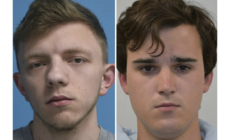
In a London courtroom on Monday, two men in their 20s were convicted for taking part in a string of arson attacks on two houses and a car, all linked to British Prime Minister Keir Starmer.
But the powers pulling the strings of 22-year-old Ukrainian national, Roman Lavrynovych, and Ukrainian-born Romanian citizen Stanislav Carpiuc, 27, as they stared down the verdict this week, were the elephant in the courthouse.
The attacks, spanning several days in May 2025, were orchestrated by a Russian-speaking handler known as El Money, evidence presented to the court showed.
Earlier this year, a U.K. prosecutor said Lavrynovych, Carpiuc and a third man were offered payment to set fire to the properties and vehicle in north London.
The contact soliciting the acts, prosecutor Duncan Atkinson said, spoke Russian.
A ‘Staggeringly Reckless’ Campaign of Sabotage
Lavrynovych was also convicted of two counts of arson being reckless as to whether life would be endangered. The third man, Petro Pochynok, was found not guilty of conspiracy to commit arson.
Shortly after Monday’s judgment, the BBC reported that Lavrynovych—21 at the time—was offered Russian citizenship in messages from El Money, who praised Russian President Vladimir Putin.
The broadcaster identified El Money—who reportedly used the initials “EL” on the Telegram messaging app—as a 23-year-old son of a senior Russian official, a young diplomat drilled in information warfare by the name of Evgeny Lyukshin who sits close to the seat of power in the Kremlin.
Newsweek could not independently verify the claim and has contacted the Russian Embassy in London via email on Tuesday.
This is the latest nod to what European officials and intelligence agencies have framed as a widespread Russian sabotage and misinformation campaign across the continent, which particularly targets countries that have supported Ukraine’s yearslong war effort against Moscow.
Richard Moore, the former chief of the U.K.’s Secret Intelligence Service—better known as MI6—said on Tuesday Putin is “trying to intimidate” the U.K., including through sabotage acts.
While still in post in 2024, Moore said Russia was carrying out a “staggeringly reckless” campaign of sabotage against Kyiv’s backers.
Russia, however, has repeatedly brushed this off.
“We reject any attempt to associate Russia or its foreign ministry with unlawful activities,” the Russian Embassy in the U.K. said in a statement carried by the BBC this week.
Moscow poses “no threat to the United Kingdom or its people,” it added.
Russian Influence Not on Trial
But the prosecution’s case against the three men entirely swerved any possible Russian involvement.
After the conviction came in, the Crown Prosecution Service said it had “made clear that the case did not depend on proving political or ideological motivation, nor on whether the defendants knew the properties were linked to the Prime Minister.”
The case instead hinged only on the dangers of setting fires in residential areas. The fires were lit in a well-populated area of north London between May 8 and May 12 last year.
The Metropolitan Police circled slightly closer to acknowledging potential Russian involvement, but did not point to state-level activity.
The force said its detectives discovered contact on the Telegram messaging app—popular in Russia and Ukraine—between Lavrynovych and El Money, as well as exchanges between El Money and Carpiuc.
El Money, the police said, communicated in Russian while Carpiuc and Lavrynovych stuck to Ukrainian.
Police swarmed on Carpiuc just minutes before he boarded a plane to Romania at London’s Luton airport. Lavrynovych was taken into custody at his home.
Detectives found evidence of white spirit used in one of the arson attacks on Lavrynovych’s shoes, and CCTV footage showed him buying the accelerant at a hardware store. Lavrynovych and Carpiuc are due to be sentenced on Friday.
Even Lavrynovych’s lawyer, James Scobie, called his client a “vulnerable, ignorant” puppet in the hands of the “devil in the background.” This demonic figure, however, was never named.
But the case fits patterns of Russian state-orchestrated sabotage, Commander Dominic Murphy, who until recently headed the Metropolitan Police’s counterterrorism teams in London, including investigations into the Starmer-linked fires, told The Associated Press.
Identifying Russia’s Hand in Sabotage
Publicly revealing the culprits of covert sabotage campaigns can be complicated. Sometimes intelligence can’t be released to the general public, while in other cases, it’s very difficult to be sure who is actually behind an action—or even if damage is deliberate.
But it emerged in late 2024 that Western intelligence officials suspected Russia of plotting to put incendiary devices aboard cargo planes, including aircraft bound for the U.S.
Four packages were sent from Lithuania to the U.K. and Poland in July 2024, one of which caught fire just before it was loaded onto an aircraft in Germany. Another caught fire in a warehouse in the U.K. and a third set ablaze on a truck in Poland.
The devices ignited a joint push from five different countries to catch those responsible.
By March 2026, Germany, Lithuania, Poland, the Netherlands and the U.K. said they had identified 22 suspected perpetrators, recruited from Russia, the three Baltic states and Ukraine. Most of these individuals were in a precarious financial position, police and security agencies from the five NATO countries said.
“It is suspected that the acts carried out by these suspects were executed on behalf of the military-intelligence service of the Russian Federation,” these nations added.