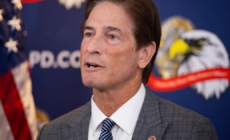
With the first tranche of money from Los Angeles County’s $4-billion sex abuse settlement scheduled to hit victims’ bank accounts next week, the county’s district attorney made a last-ditch effort Monday to stop the payouts, which he says are rife with fake claims.
Dist. Atty. Nathan Hochman asked the judge presiding over the case to halt the historic payout, while the county’s legal team fought to keep the deal on track.
“This is among the most remarkable things I’ve ever seen as a legal professional,” said Superior Court Judge Lawrence Riff, who oversees the bulk of the sex abuse cases.
“We have the county of Los Angeles with its county counsel’s office, which is a very substantial and sophisticated office, telling me this payment program should go forward,” Riff said. “And I have the D.A. from the same county telling me it shouldn’t, and that the county of Los Angeles is inadequate to protect these funds.”
Riff held off on making a decision on Hochman’s request for a six-month delay, asking the lawyers to halt payments until another hearing scheduled for June 25. The six-month delay was vehemently opposed by most plaintiff attorneys, who say their clients have suffered horrific abuse and are in desperate need of cash.
“I believe some of my clients will die before they get paid if this is delayed,” said attorney Raymond Boucher.
A six-month delay, Boucher argued, could lead to as much as $30 million carved out of plaintiffs’ profits due to the staggering number of impoverished clients who have taken out high-interest loans against their expected payouts.
“It’s been one ‘screw you’ after another,” said Nate Cervantes, 44, who sued over abuse that he said occurred at two county facilities. He said his roughly $10,000 in loans would spiral into about $25,000 in debt.
“I’m still having nightmares every night. I’m still having to bring up the story again and again. It keeps opening old wounds. When can I get the money so I can go try and get hypnosis or something?” Cervantes said. “What else do I need to do?”
The county agreed to the nation’s largest sex abuse settlement in April 2025 to settle more than 11,000 claims of sexual abuse that allegedly occurred in county-run juvenile halls, foster homes and a children’s shelter. The claims, many of which date back decades, came after California changed the statute of limitations to give victims who were sexually abused as children a new window in which to sue.
“Do I close my eyes to the district attorney coming in here saying there may be billions of dollars of fraud occurring?” Riff asked.
Judge Lawrence P. Riff, who is overseeing the bulk of L.A. County’s sex abuse cases, presides over a court hearing in February.
(Myung J. Chun / Los Angeles Times)
Andy Baum, outside counsel for the county, skirted around taking a position on the delay, saying plaintiffs’ attorneys warned him that the settlement was at risk of falling apart. The county has long viewed the $4-billion payout as a bargain compared to what it would cost to take the cases to trial.
“I was told that a number of plaintiffs would seek to blow up the settlement,” Baum said, adding that further delays would create a “very significant economic crisis potential.”
Hochman’s claim of rampant fraud sparked fury among some victims and their lawyers, who said the district attorney’s shocking statistics were inflammatory and presented without “a scintilla of supporting evidence.”
Riff said the main players in the settlement, himself included, had been kept in the dark about Hochman’s investigation. “We don’t really know what he has,” the judge said.
“Shouldn’t he tell us?” countered Boris Treyzon, an attorney whose firm represents about 1,700 clients.
Hochman said he had access to unspecified databases that suggested the vast majority of cases have “fraud indicators,” though he said he would only detail specifics in a private meeting with the judge. At a “20,000-foot level,” Hochman said, the databases available to his office suggested a vast majority of plaintiffs were never housed in the facilities where they said they were abused.
The county had appointed two Superior Court judges to review the claims for fraud, but Hochman said he believed the vetting that could be conducted by criminal prosecutors in his office was “far superior.”
Under state law, California counties are required to destroy many criminal records for juveniles, leaving the county with almost no visibility into who was in their facilities decades ago. Some attorneys pushed back on the concept that L.A. County prosecutors had unique access to records, arguing that Hochman’s data have proved “imperfect.”
“The information is largely gone,” said Boucher, noting that one of his clients who ended up on the D.A.’s fraud list was, in fact, at the children’s shelter where they claimed they were abused, according to school transcripts. “
Steven Krueger, 63, said his was one of the cases that was flagged as fraudulent by the district attorney in November because they didn’t have records of him in the county facility. He said he was amazed to see prosecutors come after him rather than the men he alleged molested him as a kid at MacLaren Children’s Center and a juvenile hall where he was sent after he stole a skateboard.
“I ain’t no fraudster,” he said. “You think you’re coming to the finish line, and they move the finish line back further.”