The only total solar eclipse of 2026 has people looking to the skies as darkness falls across part of the Northern Hemisphere on Wednesday. Crowds have gathered all across Europe to see it, with northern Spain a peak viewing location in the path of totality.
First, if you’ve never had the opportunity to see a solar eclipse, what you are watching is the moon passing in front of the sun. It occurs somewhere on Earth about every 18 months, but in any one particular spot on the globe they could happen hundreds of years apart.
Here’s what to know about when and where to see the total solar eclipse:
Where will the solar eclipse be visible?
Many of the best places to view totality are not inhabited, like northern Greenland. But western Iceland and northern Spain are also on the path of totality for a peak eclipse experience.
In Spain, they have not experienced a total solar eclipse since 1905.
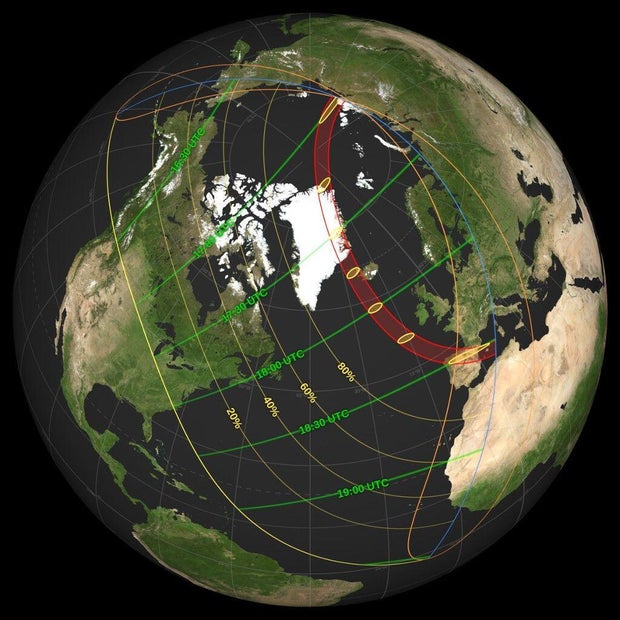
This animation from NASA shows the path of totality for the eclipse, along with the time when it will cross those areas:
Even though totality will be visible in only a few populated regions, a partial solar eclipse will be visible in a much wider area. About 230 million people will be able to see 90% totality, according to population data from the Center for International Earth Science Information Network at Columbia University.
Most major cities in Europe will see at least 90% totality, including Madrid, London and Paris.
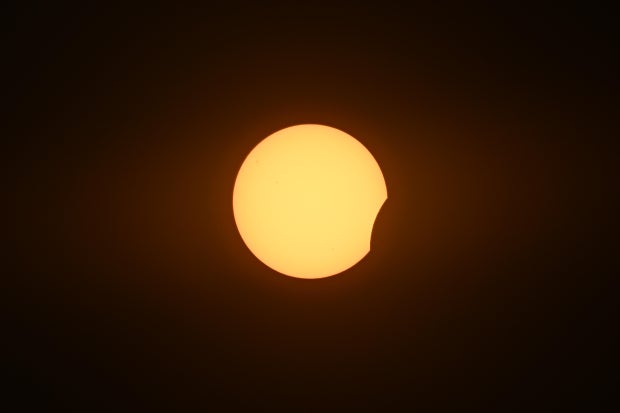
The beginning of the solar eclipse is seen in Palencia, Spain.
Leon Neal / Getty Images
Even some of North America will get a chance to see a partial solar eclipse, though it won’t be nearly as impressive as when the U.S. got to see a total eclipse in 2024. The best place to see it in the U.S. is in Fairbanks, Alaska, where it will reach 37% totality.
Boston will see 16% totality, while New York City will see about 9% totality, Toronto will see about 8% and Philadelphia will see 7%.
What time does the eclipse happen?
Since the eclipse is crossing just the northern part of the globe, the path of totality will be fairly short from start to finish, about an hour and 45 minutes.
The first glimpse of the total eclipse became visible in extreme northern Russia at 17:00 UTC, which is 1 p.m. Eastern time.
It reached northeast Greenland by 1:30 p.m. ET and western Iceland by about 1:45 p.m. ET (totality came at exactly 5:48 p.m. local time in Reykjavík).
After crossing the northern Atlantic for 45 minutes — when it will be best visible in the U.K., with London reaching its max of 91% at 2:13 p.m. ET (7:13 p.m. local time) — totality will reach northern Spain at about 2:30 p.m. ET (exactly 8:32 p.m. local time in Valencia).
The whole path will be over by 2:45 p.m. ET.
The path of totality in the 2026 solar eclipse crosses parts of Greenland, Iceland and northern Spain.
NASA
For those in North America seeing a partial eclipse, it will be most full in Toronto at 1:40 p.m. and New York City at 1:54 p.m. local time. In Fairbanks, you’d need to get up early to see its fullest point at 8:27 a.m. local time.
How do I watch the eclipse in person?
If you are lucky enough to be in one of the locations where the solar eclipse reaches totality, it will last for about two minutes.
You will need to wear solar eclipse glasses to safely view the sun during the event to protect your retinas from damage. You can take your glasses off for the brief period when it’s at totality.
If you’re outside the path of totality but lucky enough to at least get a partial eclipse, you’ll have to leave those glasses on the whole time to avoid eye damage.
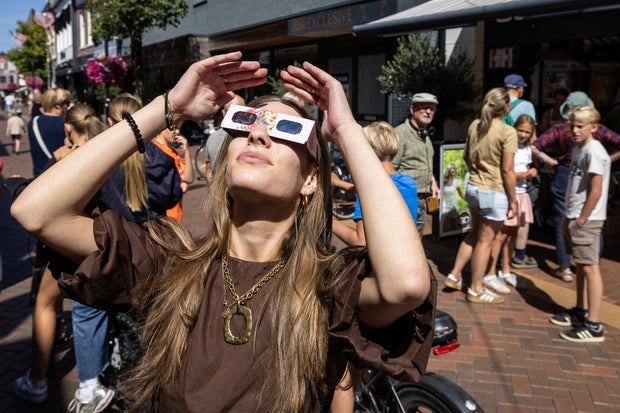
A woman tries out eclipse glasses in Almelo, eastern Netherlands, on Aug. 11, 2026, on the eve of the solar eclipse.
Vincent Jannink / ANP /AFP via Getty Images
When is the next total solar eclipse in the U.S.?
If hearing about the total solar eclipse in Europe gets you excited for the next one in the U.S., you have some time to wait.
The next total solar eclipse over the U.S. will be in 2044, but that one will only be visible in three states: Montana, North Dakota and South Dakota.
The next year, there will be another opportunity visible in many states as it moves from coast to coast. The eclipse will start in Northern California and move in an arc toward the east, ending in Florida, similar to one in 2017. There will be numerous U.S. cities where eclipse watchers can view the total eclipse, including Reno, Nevada; Colorado Springs; Tulsa, Oklahoma; Little Rock, Arkansas; Jackson, Mississippi; and Orlando, Florida.
There will be another in 2052 that crosses the Southeast, including Florida, Georgia and South Carolina.
To see a total eclipse in the northeastern U.S., you’ll have to wait all the way until May 1, 2079.
How to watch coverage of the 2026 total solar eclipse
What: Total solar eclipse across parts of the Northern Hemisphere
Date: Aug. 12, 2026
Time: Live coverage begins at 2 p.m. ET
Location: The path of totality stretches from extreme northern Russia across parts of Greenland, Iceland and Spain. Most major cities in Europe will see at least 90% totality, including Madrid, London and Paris. CBS News live streaming coverage will feature Rob Marciano in Mallorca, Spain, where totality hits at about 2:30 p.m. ET.