NEWYou can now listen to Fox News articles!
Paul C. in Washington, D.C., received an alarming text claiming Apple Pay had already charged him $8,250 and another $8,250 would go through in 35 minutes. That is the kind of message designed to make your stomach drop before you have time to think.
Paul did the smart thing. He stopped, avoided the callback number and sent the text to us. Let’s break down every red flag and show you how to verify a charge without handing control to a scammer.
New! Free live CyberGuy class: Protect Your Money From Today’s Biggest Threats
Join us Saturday, Aug. 29, at 10 a.m. ET for a free CyberGuy LIVE class covering five simple steps to help defend yourself against AI scams, fraud, identity theft and financial hacks. Kurt “CyberGuy” Knutsson will explain how to set up bank alerts, strengthen your account logins, protect your phone number, freeze your credit and help secure your retirement savings against unauthorized transfers. No technical experience is needed. You’ll also receive our financial protection checklist, and every registrant will get a link to the class recording afterward.
Reserve your free spot today at CyberGuyLive.com.
FAKE BOOKING.COM TRAVEL CREDIT SCAM TARGETS TRAVELERS
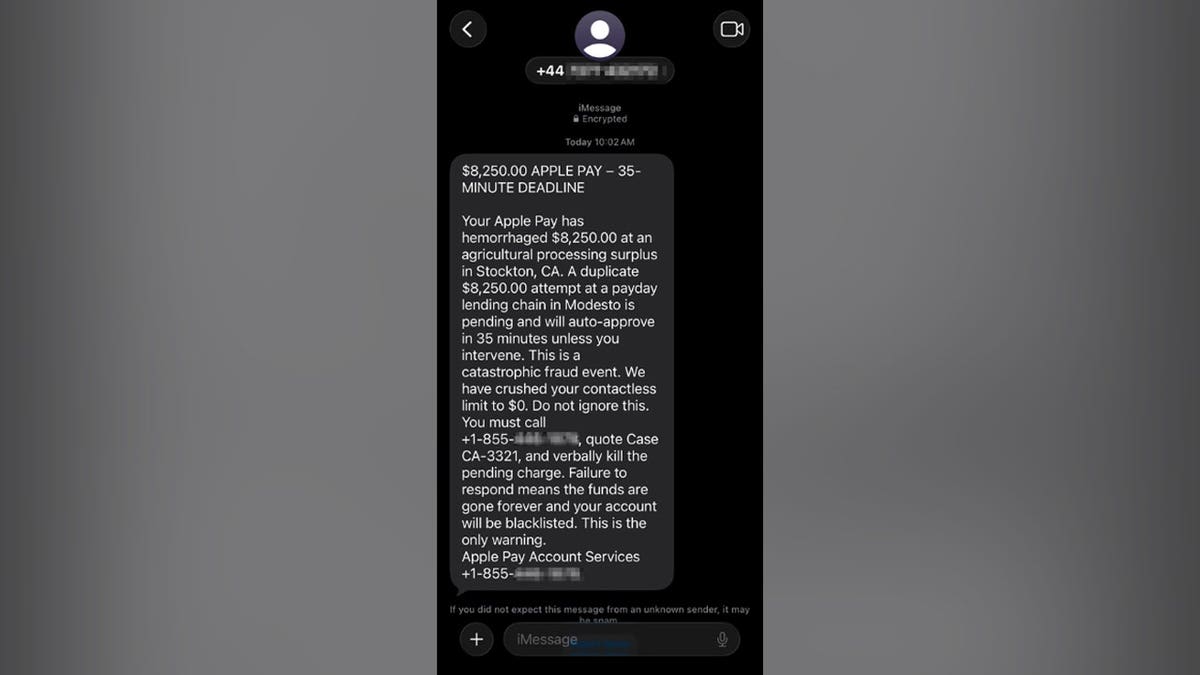
A scam text falsely warns of an $8,250 Apple Pay charge and threatens another $8,250 transaction within 35 minutes to pressure recipients into calling scammers. (Kurt “CyberGuy” Knutsson)
The Apple Pay scam text Paul received
The message claimed $8,250 had already been charged through Apple Pay and warned that a duplicate $8,250 transaction would “auto-approve” in 35 minutes. It told Paul to call an 855 number, quote “Case CA-3321” and “verbally kill the pending charge.” We partially masked the callback number so no one calls it accidentally.
Every red flag hiding in this Apple Pay scam text
The message looks chaotic, but nearly every phrase has a purpose. The sender uses dramatic wording, fake authority and a tight deadline to push Paul toward one action: calling the number in the text.
1) The sender and callback numbers do not match
The message came from a number beginning with +44, the international calling code for the United Kingdom. Yet it claims to come from “Apple Pay Account Services” and tells Paul in Washington, D.C., to call a separate 855 toll-free number. A different callback number does not automatically prove fraud. However, an overseas sender directing a U.S. recipient to an unrelated support line should make you stop before calling.
2) The Apple Pay branding creates false trust
The text uses the Apple Pay name several times and signs off as “Apple Pay Account Services.” It also arrived as a blue iMessage with the word “Encrypted” shown beneath it. Those details can make the message feel official. However, encryption only means the message was protected while traveling between devices. It does not confirm that Apple sent it. The signature also sounds generic. It does not name Paul’s bank, identify the card involved or provide an official Apple support channel.
3) The huge charge and countdown are designed to trigger panic
The first line reads: “$8,250.00 APPLE PAY – 35-MINUTE DEADLINE.” The message then claims $8,250 has already disappeared and warns that a duplicate $8,250 charge will be approved in 35 minutes. That raises the threatened loss to $16,500. The exact 35-minute deadline feels calculated. It gives Paul enough time to call while discouraging him from checking Wallet, opening his bank’s app or asking someone else for advice.
4) The wording sounds nothing like a real financial alert
The message says Paul’s Apple Pay account has “hemorrhaged” money. It calls the situation a “catastrophic fraud event” and claims his contactless limit has been “crushed” to $0. It later tells him to “verbally kill the pending charge.” Those words sound dramatic because they are meant to produce fear. A legitimate financial alert would normally use clear terms such as charged, declined, frozen or pending. It would not describe an account as hemorrhaging money or ask you to kill a charge.
5) The supposed merchants make little sense
The first transaction allegedly happened at: “an agricultural processing surplus in Stockton, CA.” The second supposedly involved: “a payday lending chain in Modesto.” Neither phrase identifies an actual merchant. They sound specific at first because they include industries and real California cities. However, they fall apart when you look closer. A legitimate transaction alert would usually show the merchant’s name. It would not rely on vague descriptions such as “agricultural processing surplus.”
6) The payment story contradicts itself
The sender claims Paul’s contactless spending limit has been “crushed to $0.” In the same message, it says the second $8,250 transaction is pending and “will auto-approve in 35 minutes.” Those claims do not fit together. If the sender had already blocked contactless activity, why would another contactless charge automatically go through? The contradiction matters because it shows the message was written to create panic rather than explain a real account problem.
7) Every instruction leads back to the scammer
The message says: “Do not ignore this.” It then orders Paul: “You must call.” The sender provides a case number, tells him to “verbally kill” the charge and warns that the money will be “gone forever” if he fails to respond. It also threatens to blacklist his account and calls this his “only warning.” That language gives Paul one supposed solution: call the number in the text. The message never tells him to open Wallet, check his bank’s official app or call the number printed on his card. That is the biggest red flag of all. Every part of the message funnels him toward a stranger waiting on the other end of the phone.
AMAZON RECALL TEXT SCAM COMES WITH RED FLAGS
Apple Pay users should verify suspicious charges through Wallet, their bank’s official app or the number printed on their card — not contact information in an unexpected text. (Qilai Shen/Bloomberg via Getty Images)
How this Apple Pay callback scam likely works
The text serves as bait. The phone call allows the scammer to take control of the conversation. Once you call, the person may claim to see your account. They could ask for your name, card number or Apple Account email. Next, they may request a verification code and describe it as a way to cancel the charge.
A scammer could also ask you to install a remote-access app. That would let the person view your screen or guide you through financial transactions. Some callback scams eventually instruct people to transfer money into a “safe” account. Others claim they sent an oversized refund and demand that the extra money be returned.
The FTC warns that fake support agents may seek remote access, steal card information or convince people to move money. CyberGuy previously heard from another person whose Apple Pay scam text nearly led to a $15,000 loss. In that case, the caller used personal information and pressure to keep her on the phone while she drove to her bank.
How to check whether an Apple Pay charge is real
Do not call the number in the text. Instead, check through channels you already trust:
- Open the Wallet app on your iPhone.
- Select the credit or debit card involved.
- Tap the Transactions tab.
- Review the latest activity.
- Open your bank or card issuer’s official app for the full account history.
- Call the number on the back of the physical card if anything looks wrong.
Apple notes that Wallet may not display the complete transaction history for every card. Your bank or card issuer remains the best source for questions about an Apple Pay charge. Do not rely on a phone number from a text, caller ID or sponsored search result.
How to report the fake Apple Pay text
Before deleting the message, save a screenshot that includes the sender information.
On an iPhone:
- Tap Report Spam or Report Junk under the message, depending on what appears.
- Block the sender.
- Delete the conversation.
- Email the screenshot to reportphishing@apple.com.
- Forward the unwanted text to 7726, which spells SPAM.
- File a report with the FTC at ReportFraud.ftc.gov.
Apple recommends emailing screenshots of suspicious Apple text messages to its phishing address. It also lets iPhone owners report junk directly inside Messages. For more ways to handle messages like this, see our guide on how to protect yourself from tech support scams.
What to do if you already called the number
Hang up as soon as you suspect fraud. Then take action based on what you shared:
- You only called: Block the number and watch for follow-up calls or texts. Scammers may now know that your phone number reaches a real person.
- You provided a card or bank number: Contact the financial institution through its official app or the number on the card. Ask it to secure the account and review recent activity.
- You shared an Apple Account password: Change that password immediately. Confirm that two-factor authentication remains enabled and review the devices connected to your Apple Account. Apple recommends changing the password right away when information may have been entered into a scam site or given to a scammer.
- You gave away a verification code: Contact the affected company immediately. Never approve an unexpected login request.
- You installed remote-access software: Disconnect the device from the internet. Remove the remote-access software, then run a full security scan using strong antivirus software. Get my picks for the best 2026 antivirus protection winners for your Windows, Mac, Android and iOS devices at CyberGuy.com. If the scammer may have seen your financial information, contact your bank from a different trusted device.
- You shared your Social Security number: Place a free credit freeze with Equifax, Experian and TransUnion. Continue monitoring your credit reports for unfamiliar accounts.
FAKE SHINYHUNTERS SEXTORTION EMAIL USES CARNIVAL BREACH DATA
Apple says malicious websites could exploit a Safari flaw to steal passwords or payment information from unpatched iPhones and iPads. (Photographer: David Paul Morris/Bloomberg via Getty Images)
Ways to protect yourself from similar scam texts
These steps can help you check the warning safely without following the scammer’s script.
1) Slow down when a message starts a countdown
A deadline can make a fake warning feel real. Give yourself time to check the account independently. A legitimate fraud department will still be there after you close the text and open the official app.
2) Verify the charge through a trusted channel
Do not call the number in the text or reply to the sender. Instead, open Wallet or your bank’s official app and review recent transactions. You can also call the number printed on the back of your card. Never rely on contact information supplied in an unexpected message.
3) Never provide verification codes or remote access
A security code can approve a login, password reset or payment. Never read one to a caller, even when the person claims it will cancel a fraudulent charge. Also, do not install an app or share your screen because someone says they need access to fix the problem. Apple representatives will not ask for your password, device passcode or two-factor authentication code.
The message Paul received contains no link. Therefore, antivirus software would not stop the pressure created by the text or phone call. However, scam campaigns can quickly change tactics. A later message may include a fake Apple login page or another dangerous site. Strong security software can detect malicious links and warn you about known scam pages. Get my picks for the best 2026 antivirus protection winners for your Windows, Mac, Android and iOS devices at CyberGuy.com.
5) Remove personal information from data broker sites
The text sent to Paul did not include his name or other private details. However, callers may use information from data brokers or past breaches to make their stories sound credible. A data removal service can reduce the amount of personal information available through people-search sites. It cannot erase every record or stop every scam. Still, less exposed data gives criminals fewer details to use against you. Check out my top picks for data removal services and get a free scan to find out if your personal information is already out on the web by visiting CyberGuy.com.
6) Add identity and credit monitoring after exposure
Consider stronger monitoring if you shared sensitive information or continue receiving targeted financial scams. Identity theft protection can alert you when someone opens a new credit account. It may also notify you when monitored information appears in known breaches. The service cannot prevent every form of identity theft. Therefore, you still need to review alerts and secure affected accounts. See my tips and best picks on Best Identity Theft Protection at CyberGuy.com.
7) Report and block the scam text
Reporting the message may help Apple and your carrier identify similar scams. On an iPhone, tap Report Spam or Report Junk beneath the message, depending on the option shown. Then block the sender and delete the conversation. You can also forward the text to 7726, which spells SPAM. Because this message impersonates Apple, take a screenshot and email it to reportphishing@apple.com.
Kurt’s key takeaways
This Apple Pay scam piles on fear from the opening line. The $8,250 charge grabs your attention, while the 35-minute deadline tries to stop you from checking whether any of it is real. Even the strange phrases serve a purpose because they keep the message sounding urgent and severe. Paul made the right move by pausing instead of calling. When an unexpected fraud alert arrives, leave the message and check through Wallet, your bank’s official app or the number printed on your card. Never give a caller a verification code or access to your screen.
Have you received a convincing Apple Pay alert or another scam text that nearly fooled you? Write to us at CyberGuy.com and tell us what the message said and how you spotted the warning signs.
CLICK HERE TO DOWNLOAD THE FOX NEWS APP
Sign up for my FREE CyberGuy Report
- Get my best tech tips, urgent security alerts and exclusive deals delivered straight to your inbox.
- For simple, real-world ways to spot scams early and stay protected, visit CyberGuy.com – trusted by millions who watch CyberGuy on TV daily.
- Plus, you’ll get instant access to my Ultimate Scam Survival Guide free when you join.
Copyright 2026 CyberGuy.com. All rights reserved.
Kurt “CyberGuy” Knutsson is an award-winning tech journalist who has a deep love of technology, gear and gadgets that make life better with his contributions for Fox News & FOX Business beginning mornings on “FOX & Friends.” Got a tech question? Get Kurt’s free CyberGuy Newsletter, share your voice, a story idea or comment at CyberGuy.com.