After the twin quakes in Venezuela last month, 73 firefighters from Los Angeles County’s Urban Search and Rescue Team were quickly deployed to the devastation to help dig out and treat survivors from one of that country’s worst disasters.
The work was dangerous, heart-wrenching and exhausting.
But back in Pacoima, a little-known county crew working from a two-story warehouse under the flight path of Whiteman Airport was providing another vital service: supporting and keeping informed the U.S. families of those firefighters.
Just like the search and rescue team in the disaster zone, the three-member Deployment Support Team in Pacoima was on duty 24 hours a day throughout the rescue mission.
“We’re in the deployment just like everybody else,” team leader Greg Short said. “So, when the team’s deployed, the DST is deployed, we’re all working together.”
The twin quakes struck Venezuela on June 24 and by the evening of the next day, the Los Angeles County team of 73 crew members, six canine teams and 80,000 pounds of equipment were on their way to March Air Force Base in Riverside. They flew out early the next morning.
Megan Yanez stands next to crates that contain cots, medicine, meals, water and equipment at the Pacoima facility.
(Genaro Molina/Los Angeles Times)
The team is part of the International Search And Rescue Advisory Group, which is a global organization of more than 90 countries.
In the facility in Pacoima, a conference room is set up both as a workspace for an around-the-clock mission and as a way to bridge the gap between families at home and the members of the department in the field.
One member of the team, Rebekah Drews, the family support leader, handles requests for assistance from the families.
In some cases, the requests can be simple, such as helping to fix a clogged toilet or a garage door that won’t open. But sometimes Drews fills a more impactful role, such as making sure flowers are delivered to a woman on her birthday when her firefighter husband was away in Venezuela.
Another key service is to keep families informed on the condition and progress of the deployed rescue workers.
When firefighters are deployed, the support crew hosts a conference call — every night at the same time — to update families on the disaster operation and reassure them that the search and rescue members are safe.
The calls often open with a guest speaker and close with an evening prayer, offered by a chaplain in the Los Angeles County Fire Department.
“I have realized that it’s OK to feel proud and heartbroken at the same time,” Angie Gudiel, the vice president of a group called the L.A. County Fire Wives, said on a recent evening calls. “It’s OK to cheer for your husband, while also crying because you miss him.”
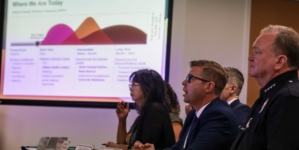
LAFD Battalion Chief Greg Short, right, team leader for the L.A. County Task Force-2 and the Deployment Support Team (DST), and DST Family Lead firefighter/paramedic Rebekah Drews wave goodbye to members of the Urban Search and Rescue (USAR) team, deployed to help in the rescue effort in Venezuela, and their family members, after participating in an evening zoom call at the County of Los Angeles Fire Department Pacoima Facility in Pacoima on June 28, 2026. After Chief Short briefs the USAR team in Venezuela, he opens the zoom meeting to team members and their families to greet each other. The DST team have been operating for 24-hours a day in Pacoima helping members of their fellow USAR Team who were deployed to Venezuela to help in the rescue effort after twin earthquakes in the South American country. (Genaro Molina/Los Angeles Times)
Firefighters with the Urban Search and Rescue (USAR) team, deployed to help in the rescue effort in Venezuela, greet their families in an evening zoom call at the County of Los Angeles Fire Department Pacoima Facility in Pacoima on June 28, 2026. After Battalion Chief Greg Short briefs the USAR team in Venezuela, he opens the zoom meeting to team members and their families to greet each other. The DST team have been operating for 24-hours a day in Pacoima helping members of their fellow USAR Team who were deployed to Venezuela to help in the rescue effort after twin earthquakes in the South American country. (Genaro Molina/Los Angeles Times)
Drews said the conference calls are also a chance to remind families that the support team is there for everyone, not just those in the field.
“Just a friendly reminder, if you guys need anything at all while your loved ones are deployed, we are here for you 24 hours a day,” Drews said during the call. “So please let us know how we can support you while your families are away in Venezuela.”
The team also works to make sure the rescue workers have the tools, food, supplies and transportation while abroad, as well as oversee the trip back home.
In the Pacoima warehouse, the three-member support team shares a room where they work, sleep and eat together. Beds fold out of cabinets across the room.
While working on the Venezuela rescue mission, Short and the other team members were recently firing up a smoker for burgers and roasted potatoes in the kitchen a floor below their conference room.
Megan Yanez looks over the Wall of Fame that features Urban Search and Rescue Team members.
(Genaro Molina/Los Angeles Times)
Short, a 25-year veteran of the county Fire Department, has worked on the search and rescue team for 23 years. His last deployment abroad was during the recovery mission after the 2017 Mexico City earthquake. He has since been leading the Deployment Support Team in Pacoima.
For Short, it’s a unique experience being on both sides of disaster response.
“My new role now gives me the perspective that I know what they’re going through and making sure that I’m providing the best support at home so they can perform in the field,” Short said.
One rescue worker in Venezuela told The Times over a spotty call that the rescue of the man found eight days after the quakes was very tedious and was like playing Jenga, because any wrong move could bring the rubble crashing down on the victim and the teams deep inside the collapsed structure.
“In our world, it’s risk versus gain,” Battalion Chief Emmanuel Sampang said from outside a tent at the team’s base camp in Venezuela. “We are going to risk a whole lot to gain a whole lot.”