MERCED, Calif. — Last year, Rosie Lee’s 19-acre farm was filled with crops including corn, beans, squash, tomatoes, melons, onions and bok choy — so much that she and her husband had plenty to sell at a farmers market.
Now, she is leaving half her land dry and unplanted. She’s uncertain how much water she can afford to pump from her well this year because the local groundwater agency has imposed pumping restrictions and fees, which could end up costing thousands of dollars.
Farmer Rosie Lee holds a flowering vegetable inside one of the greenhouses on her farm.
“It’s preventing me from growing what I used to grow,” Lee said as she stood beside a bare-dirt field. “We’re afraid that we do not make enough to pay for the water.”
While California’s landmark groundwater conservation law was designed to rein in massive agricultural overpumping, Lee and other small-scale growers say its implementation is doing the opposite — penalizing small farms while favoring industrial agribusinesses.
According to a new report, rigid fee structures and complex regulations threaten to harm California’s smallest growers, driving land consolidation in favor of deep-pocketed corporate orchards.
The report by the University of California Small Farms Network and the nonprofit group Community Alliance with Family Farmers warns that without immediate action by state and local agencies, many family farms could be forced out of business.
“Small-scale farmers across California are navigating an increasingly difficult environment,” researchers say in the report. “They are among the state’s most vulnerable groundwater users and have fewer pathways to adapt and less capacity to absorb new costs.”
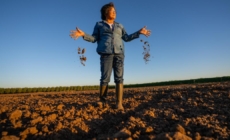
Rosie Lee stands on a dry field at her 19-acre farm near Merced, Calif.
Special accommodations should be made for those farming less than 200 acres, who often have limited resources compared to larger growers, the researchers said.
“The issue is that agencies are using a one-size-fits-all method to impose regulations, but small farms are using less water compared to larger farms,” said Ngodoo Atume, a co-author and researcher for the UC Small Farms Network.
Lee and her family grow tomatoes along with more than 20 kinds of fruits and vegetables.
The researchers suggested each local groundwater agency identify the smaller farmers, consider exempting those that use minimal water and set fees in a tiered system that allows growers who pump less to pay less.
In many areas of the San Joaquin Valley, water agencies have adopted flat fees, so the largest landowners are paying the same per-volume rate as the smallest ones.
However, small growers often have shallower wells that are more vulnerable to going dry when water levels drop. Pumping restrictions can also be more difficult for a grower with 20 acres than for a big business operating on thousands of acres.
Co-author Catherine Van Dyke, director of water policy for the Community Alliance with Family Farmers, said with the way the law is being implemented now, it “could be the final straw for a lot of businesses that are already struggling.”
The legislation led to the formation of local agencies that are responsible for halting chronic declines in groundwater levels, including by imposing pumping limits and fees. While the law has given many areas until 2040 to address overpumping, some local agencies have started clamping down.
Last year, Lee got an unexpected invoice from the Merced Irrigation-Urban Groundwater Sustainability Agency. It detailed “penalties for overextraction” and listed an amount of $15,335.
“It just gave me a real shock,” she said, “almost like a heart attack.”
Rosie Lee and her husband, Charlie Moua, show an invoice warning them that they could owe about $15,000 in penalty fees based on how much water their farm has been using.
Lee learned the agency hadn’t yet started charging penalty fees, so the invoice was more of a warning than an actual bill.
The new pumping limits and fees are going into effect this year. But she still doesn’t understand exactly how much water her family is allowed to pump, or how much money they might owe when the bill comes.
Not wanting to risk big fines that could wipe out most or all of her earnings, she decided to cut back dramatically and leave nine acres dry.
A meter measures water flow from the well on Rosie Lee’s family farm.
Just trying to understand the basics of the new rules has been difficult, Lee said.
Even after Lee met with a member of the water agency’s staff to go over her usage details, she came away confused.
Lee and her husband, Charlie Moua, still sell some produce to a local grocery but they have stopped driving their Toyota Tacoma to the Stockton farmers market because they no longer have enough to sell.
Rosie Lee, a Hmong American farmer, walks along rows of vegetables on her farm just outside Merced, Calif.
Moua said he keeps getting calls from customers asking why they aren’t selling vegetables at the market, and he explains that it’s their water problem.
The Hmong American couple hadn’t expected to be in this predicament when they started the farm in 2021 as a retirement project.
Lee, who arrived in the United States as a refugee from Laos in 1980 and worked for years as a preschool teacher, said she loves watching her crops grow and handing them over to customers.
Moua, who arrived as a student in 1973 and worked as a social worker, said he enjoys farmwork to stay active and in shape.
Rosie Lee and Charlie Moua use drip irrigation lines to conserve water on their vegetable farm.
They share the farm with relatives, who work the few remaining fields and harvest small amounts of corn, tomatoes, okra and other crops.
Lee said her family, which uses water-saving drip irrigation, should be allowed to pump more to keep the farm going.
She said it’s unfair that her family is charged the same pumping fees as the owners of giant almond and pistachio orchards.
“Big farmers, they are millionaires,” she said. “Small farms, they are just enough to survive, to raise a family.”
Farms in the Central Valley, which produce large quantities of nuts, fruits, vegetables and dairy products, have rapidly depleted groundwater in many areas.
Aquifer levels have continued to drop as corporate farms and investors have planted vast almond and pistachio orchards.
Sunrise illuminates Rosie Lee’s 19-acre farm east of Merced, Calif.
Researchers at the Public Policy Institute have estimated that as much as 900,000 acres of farmland, about 20% of the San Joaquin Valley’s irrigated land, may need to be left dry by 2040, largely because of pumping limits under SGMA.
Under the law, local agencies are responsible for setting rules, which state regulators review.
In Clovis, the local agency hasn’t yet imposed pumping restrictions, but farmer Susie Borneman Silva said she expects limits soon and doesn’t know how it will affect her small almond orchard. She supports becoming more efficient to preserve groundwater, but she’s also concerned.
“Are we going to get enough water to water our trees and stay alive and farm another year?” she said. “We want to continue farming.”
Kat Sechung sells fruits and vegetables from a farm run by Rosie Lee and her husband, Charlie Moua, in Merced County.
Farther south in Tulare County, the pumping fees are too high for small farmers, said Tekoah Kadara, associate executive director of the Allensworth Progressive Assn.
“Either the state needs to increase penalties on the giants, or they need to offer incentives for communities and small farmers,” he said.
In a recent survey, 85% of small farmers told researchers they are concerned about having to shut down their operations because of groundwater regulations, fees or other concerns.
“There should be some guarantees of enough water for a smaller farm,” said Judith Redmond, a Yolo County farmer who co-authored the report.
Without such changes, the tightening restrictions could force small farms to shut down and leave more land in the hands of large farms, she said. “It would be a great loss.”