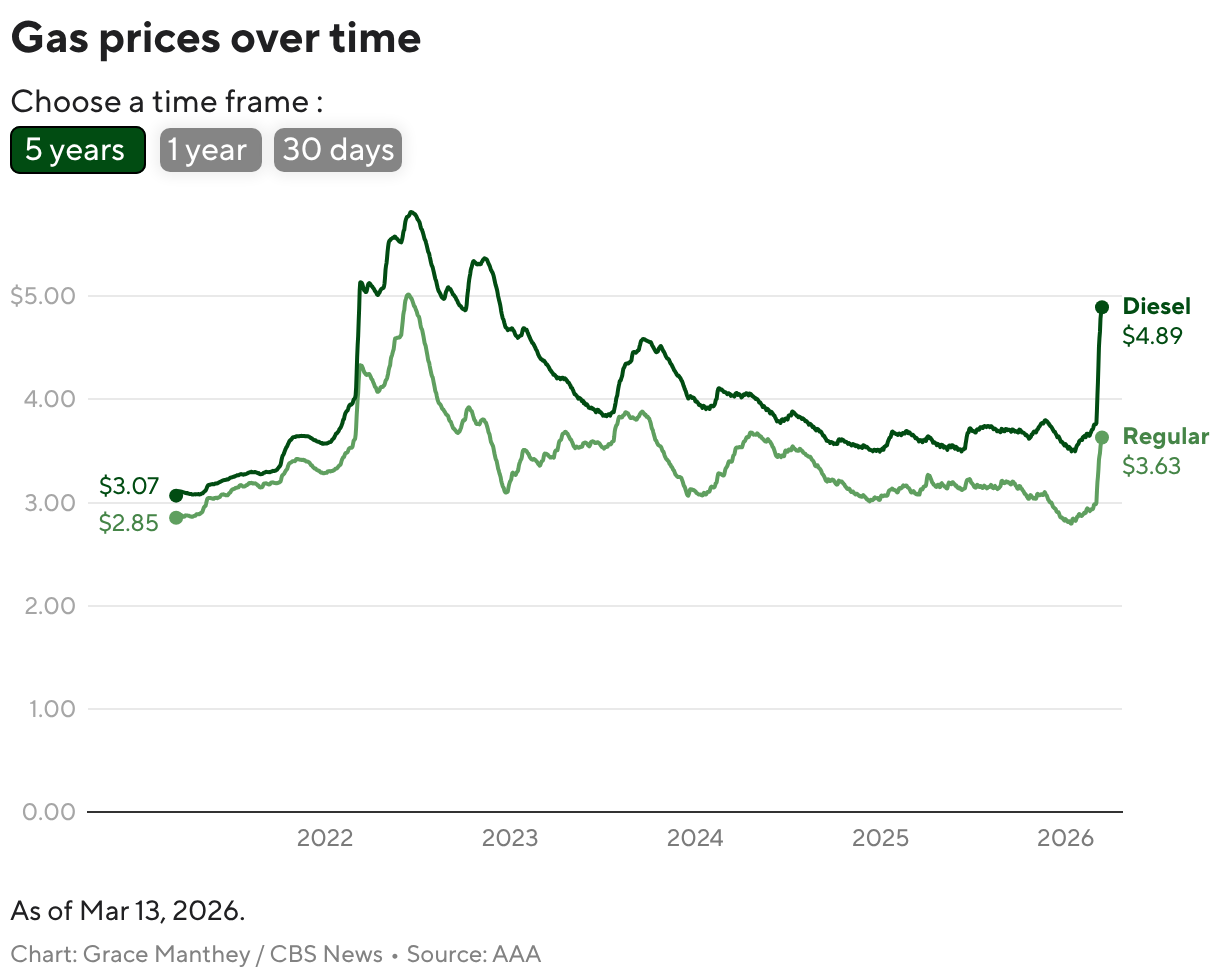
Motorists are paying sharply higher fuel prices since the outbreak of the Iran war, despite the U.S. being the world’s largest oil producer. Why?
After all, as of 2023 (the latest data available), the U.S. churned out roughly 13 million barrels of crude a day, according to the Energy Information Administration (EIA). That compares with roughly 10 million barrels from the world’s No. 2 and No. 3 producers, Russia and Saudi Arabia.
On Wednesday, the average national gas price in the U.S. rose to $3.84 a gallon, up from $2.92 a month ago, according to AAA. A gallon of diesel has shot up to more than $5, the highest level since late 2022.
Interconnected oil markets
And here’s the thing: The U.S. exports much of the oil it produces, selling it to foreign purchasers. We also remain a major importer, with the U.S also the world’s biggest user of oil, data shows.
“The global market sets the price. The provenance of the oil we’re filling out gas tanks with doesn’t matter,” said Bernard Yaros, lead U.S. economist at Oxford Economics.
The U.S. exports about 11 million barrels of its daily output, according to the EIA. It also imports roughly 8 million barrels of oil.
Much of the oil produced in the U.S. is known as “light” crude, the highest-quality oil and the type for which there is the greatest global demand. Yet most of the country’s refining capacity is optimized for a more viscous type of oil known as “heavy” crude. U.S. refineries can’t be quickly or easily reconfigured to handle lighter and low-sulfur, or “sweet,” grades of oil, explained Ernest Moniz, the former U.S. Secretary of Energy under President Obama and now an energy researcher at MIT.
“Oil from different places has different characteristics,” Willy Shih, a supply-chain expert and professor at Harvard Business School, told CBS News. “Refineries in the U.S., along the Gulf Coast in Texas, are geared toward handling a particular type of crude oil from Venezuela,” he said.
The upshot: When drivers fill up their cars, it’s often with gas produced using imported oil that was refined domestically. So when oil prices rise around the world, that also increases the cost of fuel in the U.S.
Meanwhile, surging oil prices aren’t only raising the cost of filling up cars’ gas tanks — it’s also boosting the cost of filling planes with jet fuel. That, in turn, is leading airlines to lift their fares.
A recent analysis of U.S. airline ticket prices by Deutsche Bank analysts found that average domestic airfares for travelers booking flights later in March have climbed by between 15% and 124%. The average fare for transcontinental flights has jumped over 100%, while flight prices to the Caribbean, Florida and transatlantic destinations have also risen, according to the investment bank.
“If the price of oil goes up, the price of everything goes up,” Ernest Moniz, an energy researcher at MIT and the former U.S. Secretary of Energy under President Obama, told CBS News. “Even though we are a net exporter of oil, that doesn’t change the fact that we are a major importer as well.”