The European Union is seeking more strategic clarity about the U.S. and Israel’s plans for Iran and when the conflict might end as the bloc weighs whether to send ships to help shore up security in the Persian Gulf.
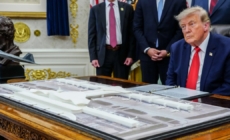
Without confirming any specific international commitments, President Trump said in a social media post on Saturday that “many Countries, especially those who are affected by Iran’s attempted closure of the Hormuz Strait, will be sending War Ships, in conjunction with the United States of America, to keep the Strait open and safe.”
He said “hopefully China, France, Japan, South Korea, the UK, and others” would send warships to join a potential effort to escort ships through the Strait, which experts say would first require a further degradation of Iran’s offensive capabilities.
“It is in our interest to keep the Strait of Hormuz open, and that’s why we are also discussing what we can do in this regard from the European side,” Kaja Kallas, the EU’s foreign policy chief, said Monday ahead of a meeting of the 27-nation bloc’s foreign ministers in Brussels.
Kallas said the EU could expand its Operation Aspides naval mission to protect shipping in the Red Sea up into the Persian Gulf, or it could form a “coalition of the willing” with member nations contributing military capacity on an ad hoc basis.
France has said it is working with other countries on a possible international mission to escort ships through the strait, but has stressed it must be when “the circumstances permit,” when fighting has subsided.
German Foreign Minister Johann Wadephul said it was important for the U.S. and Israel to define “when they consider the military aims of their deployment to have been reached,” adding: “We need more clarity here.”
Luxembourg Foreign Minister Xavier Bettel said the EU remains uncommitted to any military action.
“The fact is, for the moment, the EU is not directly part of the situation. So we need to decide if we are going to be part or not. That’s an important decision,” Bettel said.
CBS/AP