Higher U.S. gasoline prices stemming from the Iran war could effectively wipe out the fatter tax refunds many Americans are expected to collect this year, a new analysis found.
Economists from the Stanford Institute for Economic Policy Research estimate that the average U.S. household will spend an additional $740 on gas this year because of the jump in global oil prices following the attack on Iran. If that estimate holds true, it would gobble up nearly all of the additional money people are slated to collect in tax refunds this year, according to the research.
The nonpartisan Tax Foundation estimates that the average individual tax refund will be $748 higher this year because of new cuts provided under the Republican-backed “One, Big, Beautiful Bill Act,” signed into law last year by President Trump.
As of earlier this month, overall tax refunds were averaging $3,676, up 11% from the same point last year, according to the IRS.
To be sure, the eventual pocketbook hit from higher U.S. energy prices depends on how long the conflict in Iran persists and, more specifically, how long the strategic Strait of Hormuz remains effectively blocked to the tankers ferrying oil and liquid natural gas to global markets.
“Rockets and feathers”
The Stanford researchers’ calculation of the additional household gas expenditures assumes that the strait will remain closed for three weeks. If tensions ease and tankers start traversing the waterway sooner, estimates of how much consumers could spend on gas would change, Neale Mahoney, director of the Stanford institute, told CBS News.
The Stanford estimate also reflects the “rockets and feathers” principle, Mahoney added — the concept that product prices are quick to shoot up when input costs climb, but tend to drift down slowly when those same costs decline.
For now, the impact on energy costs is evident. Oil prices spiked on Wednesday amid escalating attacks in the Gulf, with Brent crude rising to nearly $111 a barrel and the U.S. benchmark jumping to roughly $99.
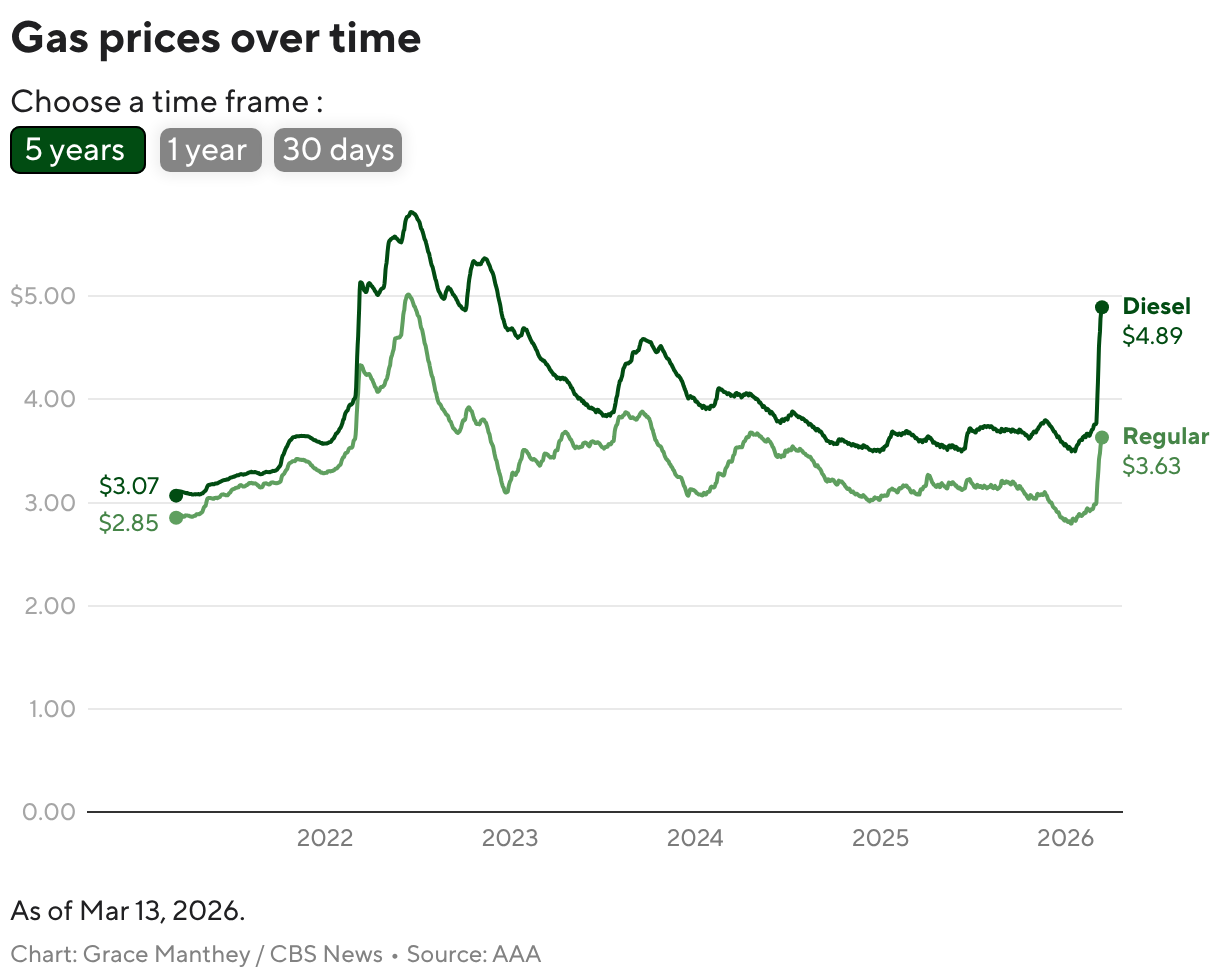
The national average gas price soared to $3.88 per gallon on Thursday, up 96 cents from one month ago, according to AAA data.
The Trump administration has touted tax cuts under the “big, beautiful bill.” The new law eliminated taxes on some overtime and tipped income, and raised the limit on the deduction for state and local taxes, or SALT, from $10,000 to $40,000.