Dubai — British maritime security firm Vanguard Tech said Tuesday that a U.S.-flagged tanker was approached by Iranian gunboats, which threatened to board the vessel, in the Strait of Hormuz, before continuing on its way under military escort. The incident comes amid a tense standoff between the U.S. and Iran, and just days ahead of expected negotiations.
The Stena Imperative was approached by three pairs of small armed boats belonging to the Iranian Revolutionary Guards Corps while transiting the Strait of Hormuz, approximately 16 nautical miles north of Oman’s coast, the company said.
The gunboats hailed the tanker by radio, ordering the captain “to stop the engines and prepare to be boarded,” but the ship increased speed and maintained course, the firm added, stressing that it never entered Iranian territorial waters.
“The vessel is now being escorted by a U.S. warship,” Vanguard Tech said.
U.S. Central Command issued a statement confirming the incident, saying, “Two IRGC boats and an Iranian Mohajer drone approached M/V Stena Imperative at high speeds and threatened to board and seize the tanker.”
CENTCOM spokesman Capt. Tim Hawkins said the guided-missile destroyer USS McFaul immediately responded to the scene and escorted the ship with defensive air support from the U.S. Air Force. “The situation de-escalated as a result, and the U.S.-flagged tanker is proceeding safely,” he said.
The tanker was still on course for its destination in Bahrain on Tuesday afternoon, scheduled to arrive at the port Sitrah on Feb. 5, information from the MarineTraffic website showed.
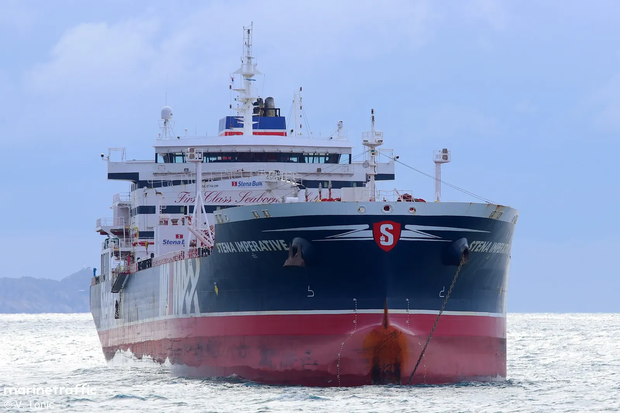
The U.S. tanker Stena Imperative is seen in a Feb. 4, 2024 file photo.
MarineTraffic.com/V. Tonic
The British maritime security agency UKMTO had reported the incident earlier, without specifying the nationality of the ship nor of the boats that approached it, saying only that it had been “hailed on VHF by numerous small armed vessels,” but ignored the request to stop and “continued on its planned route.”
“Authorities are investigating,” UKMTO said in its statement, warning all vessels in the Strait of Hormuz “to transit with caution and report any suspicious activity.”
U.S. Central Command also confirmed Tuesday that U.S. forces shot down an Iranian Shahed-139 drone that flew towards a U.S. Navy aircraft carrier, the USS Abraham Lincoln, in the Arabian Sea earlier the same day.
The Strait of Hormuz is a key passage for global transport of oil and liquefied natural gas, and it has been the scene of several incidents in the past amid tension between Iran and the West.
Iran’s Fars news agency, which is closely linked to the Revolutionary Guards, cited unnamed government officials on Tuesday as denying the report by Vanguard Tech, claiming a vessel was intercepted after it entered Iran’s territorial waters without permission.

A map shows the Strait of Hormuz, a crucial waterway between the Persian Gulf and the Gulf of Oman, with Iran to the north and the UAE and Oman exclave Musandam to the south.
Getty/iStockphoto
Tracking data from MarineTraffic showed the Imperative remained within Oman’s maritime economic zone as it traversed the Strait.
A senior Iranian official from the Revolutionary Guards threatened last week to block passage of the Strait in the event of a U.S. attack, and the Guards also held military exercises over the weekend in the strategic waterway.
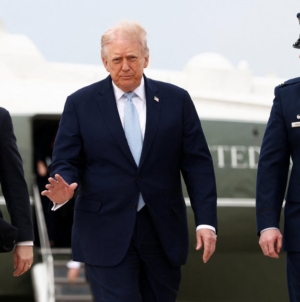
President Trump has threatened repeatedly that he could launch a new military strike on Iran over the country’s brutal suppression of recent protests, or if it declines to negotiate a new deal on its nuclear program.
Speaking to CBS News last week, Mr. Trump said “I have had” conversations with Iran in the last few days, and “I am planning” to have more.
Mr. Trump said that, in those conversations, he “told them two things. No. 1, no nuclear. And No. 2, stop killing protesters. They’re killing them by the thousands.”
At least 10 U.S. warships — including an aircraft carrier and at least five destroyers — were heading toward Iran’s coastal waters as of last week, a deployment Mr. Trump has called an “armada,” which he said he hopes he doesn’t need to use.
U.S. and Iranian officials are expected to hold talks at the end of this week.