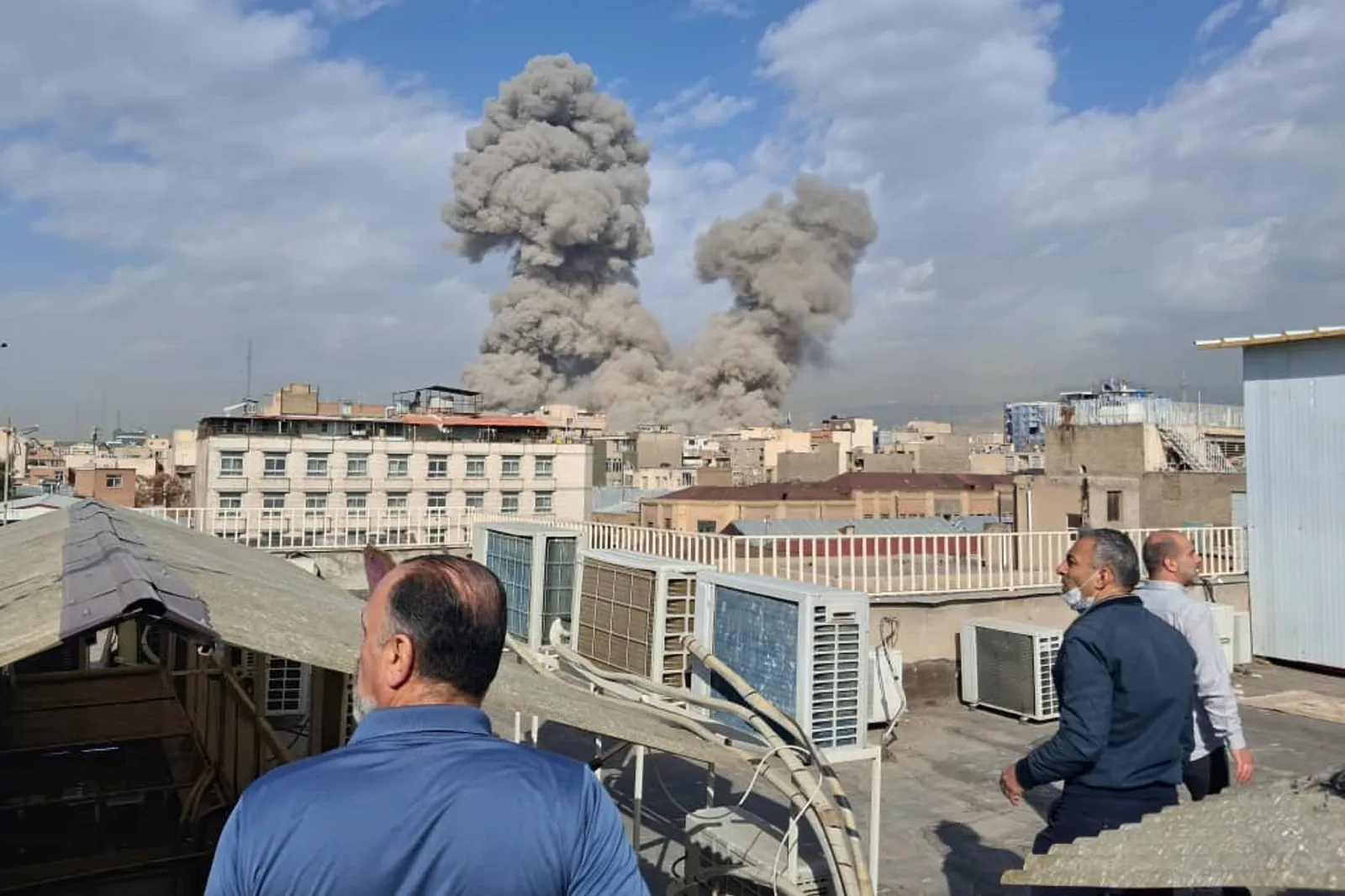
The United States and Israel launched coordinated strikes across Iran in “Operation Epic Fury” early Saturday morning, with the Islamic Republic launching retaliatory strikes across U.S. bases in the Middle East.
President Donald Trump said the strikes were intended to cripple Iran’s nuclear and missile capabilities and urged Iranians to overthrow their leaders once the operation ends, telling them to “take over your government.”
At least 57 people have been reported killed and 45 others wounded in the U.S.-Israeli strikes, according to Iran’s state-run IRNA news agency, per the Associated Press.
Why It Matters
The attacks mark a sharp escalation following recent nuclear talks between Washington and Tehran and raise the risk of a wider regional conflict. They come as the U.S. has deployed additional warships, aircraft and air defenses to the Middle East in what analysts describe as the largest U.S. buildup there since the Iraq war in 2003.
Iran has repeatedly denied pursuing a nuclear weapon and had engaged in diplomatic talks with the U.S. only days earlier to prevent military conflict.
U.S. and Israeli officials have also encouraged regime change in Iran, telling Iranians to “seize control of your destiny” and “take over your government.”
Legal experts have raised concerns about the legality of Trump’s strikes under international and U.S. domestic law, with critics pointing to Congress’s constitutional power to declare war. Under international law, the U.N. Charter bars the use of force by one state against another state except for in the cases of self-defense or if there has been U.N. Security Council authorization. The strikes were not authorized and not an act of self-defense.
Polling has consistently showed Americans are more likely to oppose than support the U.S. using military force in an attack on Iran, with a February Economist/You Gov poll finding 49 percent of Americans are somewhat or strongly opposed, while 27 percent support such an attack. That same poll of 1,551 people found 48 percent of Americans disapprove of the way Trump is handling the situation in Iran, while 31 percent approve. The poll has a margin of error of plus or minus 3.3 percentage points.
What To Know
In a speech announcing the attack on Saturday, Trump said, “Our objective is to defend the American people by eliminating imminent threats from the Iranian regime…. its menacing activities directly endanger the United States, our troops, our bases overseas, and our allies throughout the world.”
The president emphasized the reasoning behind the strikes as related to Iran’s alleged nuclear weapons program, saying, “It has always been the policy of the United States, in particular my administration, that this terrorist regime can never have a nuclear weapon. I’ll say it again, they can never have a nuclear weapon. That is why, in Operation Midnight Hammer last June, we obliterated the regime’s nuclear program at Fordow, Natanz, and Isfahan.”
Three major nuclear facilities—Fordow, Natanz and Isfahan—were damaged in U.S. strikes in June 2025, and the U.N. nuclear watchdog, the International Atomic Energy Agency (IAEA), has said it has been unable to fully assess Iran’s program since Iran curtailed inspector access after the attacks. The U.S. intelligence community has previously assessed Iran halted its nuclear weapons program in 2003, a conclusion broadly reflected in findings by the IAEA, though Iran has continued nuclear activities such as uranium enrichment, which can be used for nuclear power, of which there are non-weapons uses for.
The president also referenced Iran’s recent bloody crackdown on protestors in its country in his speech, saying, “Iran is the world’s number one state sponsor of terror and just recently killed tens of thousands of its own citizens on the street as they protested.”
He warned Iranians that “it’s very dangerous outside. Bombs will be dropping everywhere,” but once the operation is finished, “take over your government. It will be yours to take.”
Trump previously called for regime change in the country amid the deadly protests that started in late December. Israel announced it launched strikes on Iran that hit near Iranian Supreme Leader Ayatollah Ali Khamenei’s offices.
“The internal trajectory—whether the public mobilizes against the regime or whether fractures appear within the state—will hinge in part on whether the United States and Israel have a coherent endgame,” Alex Vatanka, senior fellow at the Middle East Institute, told Newsweek in an email statement on Saturday.
“That includes whether their efforts to target senior Iranian officials are successful, amid persistent rumors that several high-ranking figures have been killed,” he added.
Iranian Foreign Minister Abbas Araghchi told NBC News on Saturday that Ayatollah Khamenei and President Masoud Pezeshkian are still alive and “almost all officials are safe and sound and alive. We may have lost one or two commanders, but that is not a big problem.”
Vatanka noted that, “Without a wider, intelligence-driven plan for political transition, airstrikes alone are unlikely to generate sustained internal momentum against the Khamenei–IRGC leadership, particularly in the absence of an organized opposition ready to act.”
Reports U.S.-Israeli Strikes Targeted Ayatollah, Killed Children
The U.S.-Iran strikes on Iran appeared aimed at military and political leadership. Several senior commanders of the Islamic Revolutionary Guard Corps (IRGC) were killed, Iranian media reports.
President Pezeshkian’s residence was also targeted, and his condition is unclear. Ayatollah Khamenei has also not been seen publicly since the attacks.
The strikes and counter-strikes have also resulted in civilian casualties across Iran, with reports of school girls killed in a strike. There is widespread disruption across the country with internet and mobile networks down, but images online showed smoke from explosions in several cities.
“We are scared; we are terrified. My children are shaking, we have nowhere to go, we will die here,” Minou, a 32-year-old Iranian mother of two told Reuters.
Iranian authorities said a missile strike on a girls’ school had killed 53 people in a death toll that was still rising on Saturday afternoon, the BBC reported citing Iran’s state-run Islamic Republic News Agency (IRNA), which cited a spokesperson for the country’s ministry of education.
Ali Farhadi told IRNA that the school was “targeted by three missile attacks” and that an additional 63 people were injured in the assaults.
“The destroyed building is a primary school for girls in the south of Iran. It was bombed in broad daylight, when packed with young pupils. Dozens of innocent children have been murdered at this site alone,” Araghchi said in a post on X.
Iran Retaliation
Iran has already responded by launching missiles against Israel. Tehran also directed strikes on the United Arab Emirates (UAE), Kuwait, Qatar, Bahrain and Saudi Arabia.
Iran retains a substantial arsenal of ballistic missiles, cruise missiles and drones, along with regional proxy forces capable of targeting U.S. troops in Iraq and Syria and hitting Israeli cities.
Qatar’s Defense Ministry said the military shot down several missiles before they reached its airspace. It said the missiles were dealt with as soon as they were detected “in accordance with the pre-approved security plan.”
Bahrain said the headquarters of the U.S. Navy’s 5th Fleet has been targeted by a missile attack. Meanwhile, explosions were also heard in Kuwait and Saudi Arabia.
At least one person has died in Abu Dhabi, UAE, after the country intercepted several missiles reportedly launched from Iran, according to the Emirati defense ministry.
“Tehran is now doing what it signaled it would do: striking U.S. and Israeli targets, a pattern likely to continue in the short term, though questions remain about the effectiveness and precision of its attacks,” Vatanka told Newsweek. “Iran must also tread carefully when selecting targets in Arab states, where even a small miscalculation risks regional backlash.”
What People Are Saying
Saudi Arabia’s Foreign Ministry said in a statement: “The Kingdom affirms its full solidarity with and unwavering support for the brotherly countries, and its readiness to place all its capabilities at their disposal in support of any measures they may undertake. The Kingdom of Saudi Arabia calls on the international community to condemn these blatant attacks and to take all firm measures necessary to confront Iranian violations that undermine the security and stability of the region.”
Senator Mark Kelly, an Arizona Democrat, said in an X post: “After promising to keep America out of war and instead focus on lowering costs for families, Donald Trump has launched a large-scale military operation against Iran…When I launched on my first combat mission during Operation Desert Storm 35 years ago, I understood the mission and the end goal. So did Congress. So did the American people. That’s the minimum level of leadership this country deserves. And Donald Trump has failed again at that. The Senate needs to come back to Washington immediately and do its Constitutional duty.”
Representative Thomas Massie, a Kentucky Republican, said in an X post: I am opposed to this War. This is not “America First.” When Congress reconvenes, I will work with @RepRoKhanna to force a Congressional vote on war with Iran. The Constitution requires a vote, and your Representative needs to be on record as opposing or supporting this war.”
Vali Nasr, professor at Johns Hopkins University’s School of Advanced International Studies, said in an X post: “Iran’s aim now is to absorb US and Israeli attacks, hold its position and signal expansion of war, and wait for worried regional actors to mediate a ceasefire. They expect that if Trump does not get a quick win then he will look for an exit, and negotiations afterwards will be different.”
Secretary-General of the United Nations Antonio Guterres said in a Saturday statement: “I condemn today’s military escalation in the Middle East. The use of force by the United States & Israel against Iran, and the subsequent retaliation by Iran across the region, undermine international peace & security. All Member States must respect their obligations under international law, including the Charter of the @UN…I call for an immediate cessation of hostilities & de-escalation. Failing to do so risks a wider regional conflict with grave consequences for civilians & regional stability. I strongly encourage all parties to return immediately to the negotiating table.”
What Happens Next
Much of the region remains in limbo as governments await possible retaliatory action.
In a polarized era, the center is dismissed as bland. At Newsweek, ours is different: The Courageous Center—it’s not “both sides,” it’s sharp, challenging and alive with ideas. We follow facts, not factions. If that sounds like the kind of journalism you want to see thrive, we need you.
When you become a Newsweek Member, you support a mission to keep the center strong and vibrant. Members enjoy: Ad-free browsing, exclusive content and editor conversations. Help keep the center courageous. Join today.